Kissing arrangements in ℝ¹² · exact start of the search
Two flexible blocks, 720 fixed bridges, one more sphere
The 840-point arrangements studied here split ℝ¹² into two copies of ℝ⁶. Each copy holds a 60-point block, 12 axial points and a 48-system, and 720 bridge points put half of their length in each copy. The bridges stay put while each 48-system can turn. That freedom gives infinitely many 840-point arrangements and the starting point from which an 841st sphere was found.
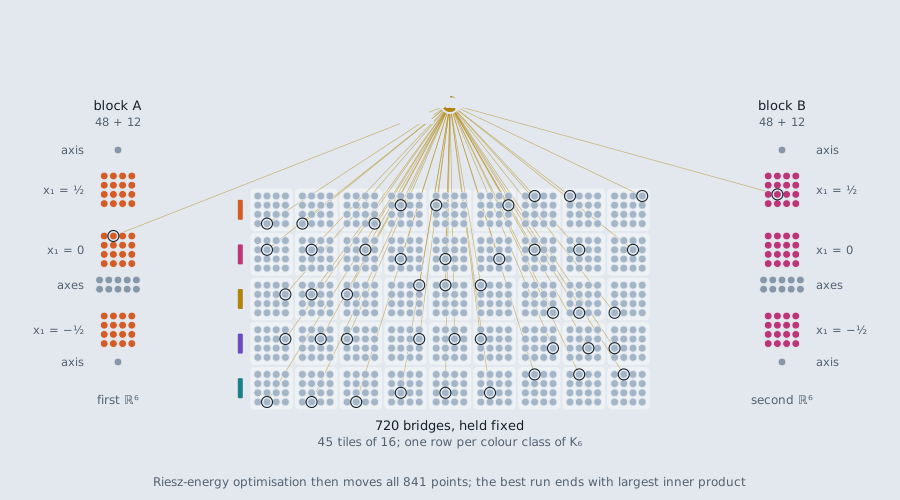
Every cap is one of the 840 points of the paper’s starting configuration, with Example 1 in both blocks. Centre: the 720 bridges ½(±eᵢ ± eⱼ ± eₖ′ ± eₗ′), one tile for each pair of edges of the same colour in K₆. Sides: the two blocks, layered by the first coordinate x₁ of their ℝ⁶: the axis ±e₁, the floors x₁ = ±½ and the equator x₁ = 0 with the other axes. Top: the extra point (±1, …, ±1)/√12 that starts the search. Each tile contains every sign pattern, so this point overlaps exactly one point per tile; for the signs drawn it also overlaps one point in each block. View full size
Bridges 720
Held fixed. Each touches 88 to 104 other points.
Axial points 2 × 12
±eᵢ in each copy of ℝ⁶. Each touches 120 or 136 points.
48-systems 2 × 48
An equator of 16 points with 10 contacts each, and two floors x₁ = ±½ of 16 points with 26 contacts each.
The 841st point 1
Riesz-energy optimisation of all 841 points ends with largest inner product 0.499999937751.
The equator loosens
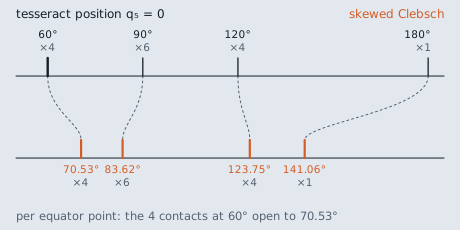
The 16 equator points are x(ε) = (√q₁ ε₁, …, √q₅ ε₅) over the even sign vectors ε. In the tesseract position q = (¼, ¼, ¼, ¼, 0), as in the classical arrangement, they span only four dimensions and each touches four others. The paper’s skewed Clebsch choice q = (2/9, 2/9, 2/9, 2/9, 1/9) uses the fifth direction: those contacts open to 70.53°, and the five obtuse neighbours, the Clebsch graph, sit at 123.75° and 141.06°.
How far a 48-system can turn
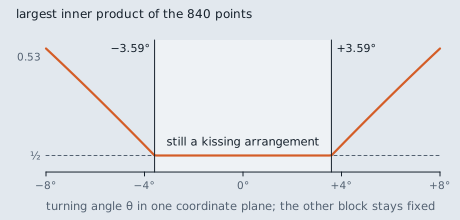
Turn one 48-system by θ in a plane of two of its first four equator coordinates and keep every other point fixed. The 840 points stay a kissing arrangement exactly while |θ| ≤ arcsin ¾ − 45° ≈ 3.59°; beyond that an equator point comes within 60° of an axial point. Theorem 2 gives a six-dimensional family: every A ∈ O(4) whose absolute row sums are at most 3/(2√2) works.
Reading the drawings
Exact. The chart shows the paper’s starting configuration: Example 1 in both blocks and the bridges from a 1-factorisation of K₆. All 352,380 inner products were checked; the largest is ½.
Tiles. Each tile is one bridge block. Its 4 × 4 grid lists the signs of the block’s two left coordinates by row and of its two right coordinates by column.
The 841st point. Its signs are random, as in the paper. Any choice overlaps exactly one point in each of the 45 tiles.
Not drawn. The final 841-point arrangement is numerical; its coordinates are not shown.
All drawings are original and computed from the definitions in the paper. Research source
About this paper
Uses flexibility in 840-point arrangements to guide optimization toward an 841-point kissing arrangement in twelve dimensions.
The construction keeps 720 bridge vectors fixed while varying two 60-point blocks. This geometric freedom provides structured initializations for logarithmic Riesz energy optimization and leads to a numerical 841-point configuration.
Citation
BibTeX
@misc{takhanov2026841stsphere,
  title = {Structure of kissing arrangements in ℝ¹² and a place for the 841st sphere},
  author = {Takhanov, Rustem and Assylbekov, Zhenisbek and Yun, Stanislav},
  year = {2026},
  eprint = {2606.18984},
  archivePrefix = {arXiv},
  url = {https://arxiv.org/pdf/2606.18984}
}