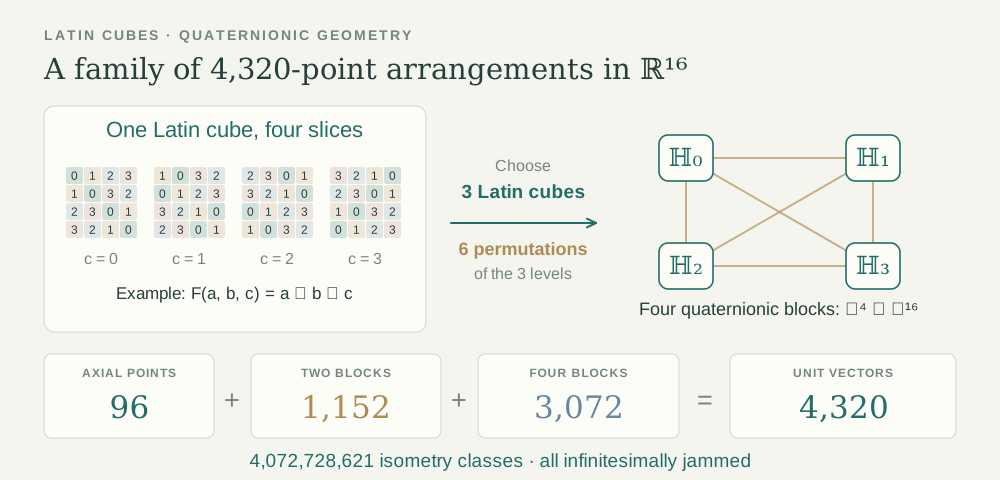
The grids show a sample order-4 Latin cube over the Klein four-group; ⊕ denotes bitwise XOR. Three independently chosen Latin cubes determine the four-block layers, while six permutations match levels between pairs of quaternionic blocks. This is a schematic of the construction, not a projection of its points. Research source
About this paper
Constructs a family of 4,320-point kissing arrangements in sixteen dimensions using Latin cubes of order four and permutations of quaternionic levels.
All arrangements in the family are antipodal and infinitesimally jammed, and their frame operator is 270 times the identity. A computer-aided enumeration gives exactly 4,072,728,621 isometry classes, revealing a vast diversity of configurations with the same size as the Barnes–Wall arrangement.
Citation
BibTeX
@misc{takhanov2026latincubes4320,
  title = {Latin cubes of order {$4$} and {$4320$}-point quaternionic constructions in {$\mathbb{R}^{16}$}},
  author = {Takhanov, Rustem},
  year = {2026},
  eprint = {2611.00927},
  archivePrefix = {arXiv},
  note = {To appear in the AIST 2026 proceedings, in Springer’s Communications in Computer and Information Science (CCIS) series.},
  url = {https://arxiv.org/pdf/2611.00927}
}