Leech lifting in ℝ²⁴ ⊕ ℝᵏ · exact slice and certified data
Lifting the Leech shell, five times over
All five new bounds start from the 196,560 minimal vectors of the Leech lattice in ℝ²⁴. Some of them, the owners, are removed; points lifted out of ℝ²⁴ take their place, and an auxiliary configuration fills the extra coordinates. Each dimension then needs one local idea: a rotation, a coordinated motion, a deformed layer or a recoloured one.
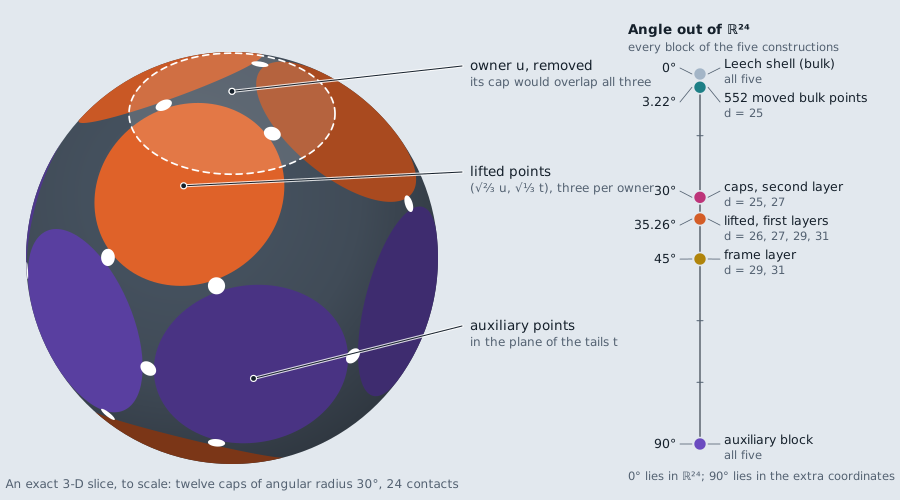
Left: the lifting lemma in one exact slice, with the tail data used in dimension 26. The 3-space spanned by an owner u and the plane of a zero-sum triangle {t₁, t₂, t₃} meets the configuration in twelve caps of true size: the lifted points (±√⅔ u, √⅓ tᵢ) around the removed owners ±u, dashed, and the auxiliary hexagon in the plane of the tᵢ. It is a kissing configuration of 12 caps in three dimensions, the most there can be, with 24 contacts. Right: the angle between each kind of block and ℝ²⁴, from the definitions in the paper. View full size
Bulk 175,904–194,989
Leech minimal vectors left in place, from d = 31 to d = 25.
Lifted points, first layers 35.26°
19,840 (d = 29), 61,968 (d = 31); first cap layers of 4,440 (d = 26) and 6,774 (d = 27).
Caps, second layer 30°
2,038 caps (x, ±½) in d = 25; 666 points in the recoloured second layer of d = 27.
Frame layer 45°
480 points (d = 29) and 672 (d = 31). It removes no bulk point.
Auxiliary block 90°
2 poles (d = 25), the hexagon (26), 12 (27), 34 (29), 122 (31).
Moved bulk 3.22°
552 bulk points of d = 25 lifted slightly to make room for one more point.
The five records
d
previous
new bound
gain
what changes
25
197,580
197,583
+3
new heads and a coordinated motion of 552 bulk points
26
199,806
199,868
+62
a deformed second cap layer and 22 heads that remove no bulk point
27
201,567
201,589
+22
a larger second cap layer, chosen by 3-colouring minimal vectors
29
209,968
209,970
+2
rotated lifted directions and a 34-point auxiliary block
31
238,662
238,666
+4
rotated lifted directions and a rotated E₇ auxiliary block
Spending the slack in dimensions 29 and 31
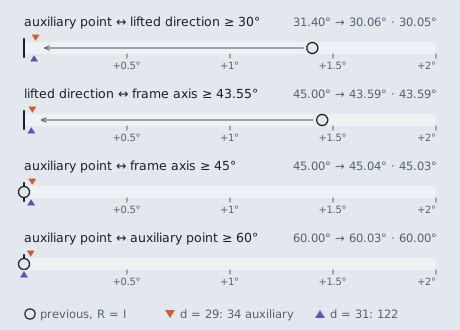
The four smallest angles that conditions (A1)–(A4) and (B1)–(B4) control, recomputed from the certificates. With the unrotated directions of the previous configurations (R = I) two of them have slack: 1.40° between auxiliary points and lifted directions, and 1.45° between lifted directions and frame axes. The certified rotations spend almost all of it, and the room this frees holds 34 auxiliary points instead of 32 in dimension 29 and 122 instead of 118 in dimension 31.
Reading the drawings
Exact slice. The globe is the 3-space spanned by u and the tail plane, drawn to scale; caps have angular radius 30°.
Heights. Each angle is the arcsine of the length of the extra-coordinate part: 1/√3 gives 35.26°, ½ gives 30°, 1/√2 gives 45° and (√6 − 2)/8 gives 3.22°. The deformed second layer of dimension 26 has no single height.
Certificates. The angles in the slack figure were recomputed in floating point from the certificate files. The bounds themselves are certified in exact arithmetic by the authors’ verifiers.
All drawings are original and computed from the definitions in the paper. Research source
About this paper
New constructions improve lower bounds for kissing numbers in dimensions 25, 26, 27, 29, and 31.
The manuscript with Stanislav Yun is available through the linked GitHub repository. The repository provides the entry point for the paper and its accompanying computational materials.
Citation
BibTeX
@misc{takhanov2026kissingdimensions2531,
  title = {New lower bounds for kissing numbers in dimensions 25, 26, 27, 29 and 31},
  author = {Takhanov, Rustem and Yun, Stanislav},
  year = {2026},
  url = {https://github.com/k-nic/kissing_d25-31/blob/main/paper.pdf}
}