ℝ¹² as ℍ³ · the 840-point quaternionic model, exact
Where the 840 points put their weight
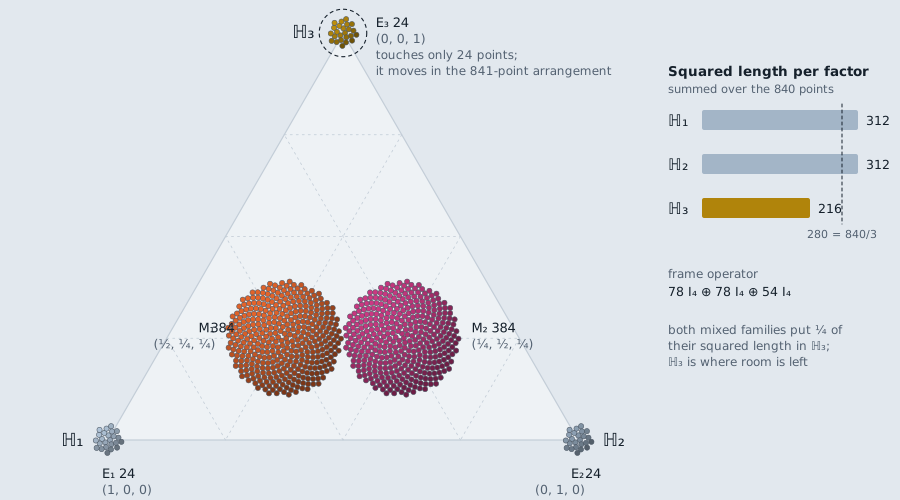
Write a point of ℝ¹² as three quaternions. The 840-point model is three axial 24-cells, one in each factor, and two families of 384 whose squared length splits as (½, ¼, ¼) and (¼, ½, ¼). The third factor carries the least weight, and that is where the numerical 841-point arrangement finds its room.
Each point x = (x₁, x₂, x₃) ∈ ℍ³ is placed at its profile (|x₁|², |x₂|², |x₃|²). Points with the same profile form one patch, one cap per point: 24 at each corner and 384 in each mixed family. Right: Σ|xₖ|² over all 840 points is 312, 312 and 216, and the frame operator is 78 I₄ ⊕ 78 I₄ ⊕ 54 I₄. Matched to this model, the numerical 841-point arrangement keeps the 816 points of E₁, E₂, M₁ and M₂ within 0.048, moves the 24 points of E₃ by 0.55 (root mean square), and places the new point mostly in ℍ₃. View full size
E₁ 24
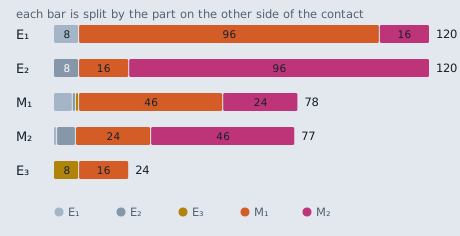
The 24 Hurwitz units in ℍ₁. Each point touches 120 others.
E₂ 24
The same in ℍ₂, with 120 contacts each.
E₃ 24
The same in ℍ₃, with only 24 contacts each: 8 inside E₃ and 16 with M₁.
M₁ 384
(a/√2, b/2, c/2) with a in the second 24-cell and b, c Hurwitz units; 78 contacts each.
M₂ 384
(a/2, b/√2, c/2) with a a Hurwitz unit and b, c in the second 24-cell; 77 contacts each.
Who touches whom
Contacts per point, inner product ½, split by the part on the other side. E₁ and E₂ are held mostly by the mixed families, with 96 + 16 contacts each. E₃ meets M₁ only 16 times per point and never touches M₂. In the numerical 841-point arrangement it is exactly E₃ that moves.
A fingerprint of the model
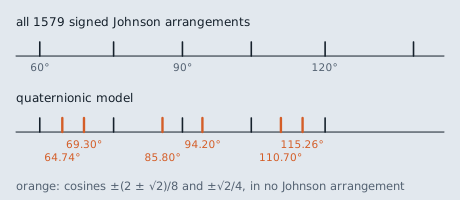
Angles between distinct points. All 1579 signed Johnson graph arrangements use only the cosines ½, ¼, 0, −¼, −½, −¾ and −1. The model also has ±(2 ± √2)/8 and ±√2/4: six angles that no Johnson arrangement has, so it is none of them. Its smallest frame-operator eigenvalue, 54, also separates it from the Clebsch-based arrangements, whose bridges alone contribute 60.
Reading the drawings
Exact. The model is rebuilt from its definition. Its 352,380 inner products reproduce the paper’s table, and the largest is ½.
Patches. All points of a patch share one profile. The spiral inside a patch only spreads the caps out and carries no information.
The 841. The residuals come from the paper’s alignment of the numerical arrangement with the model; the numerical coordinates are not drawn.
All drawings are original and computed from the definitions in the paper. Research source
About this paper
A quaternionic viewpoint reveals the structure behind a numerical 841-point kissing arrangement in twelve dimensions.
Viewing twelve-dimensional space as three quaternionic factors leads to a new 840-point model built from three orthogonal 24-cells and two 384-point families. Asymmetry between the factors helps explain the geometry of the numerical 841-point arrangement.
A building block in four dimensions
The regular 24-cell24 vertices · 96 edges
Rotate a 2D orthogonal projection of the 24-cell in ℝ⁴. Gold vertices are the eight signed coordinate vectors; green vertices are the sixteen vectors (±½, ±½, ±½, ±½). The projection illustrates one four-dimensional building block of the paper’s construction.
Citation
BibTeX
@misc{takhanov2026quaternionickissing,
  title = {A quaternionic construction behind 841-point kissing arrangement in ℝ¹²},
  author = {Takhanov, Rustem},
  year = {2026},
  eprint = {2609.09179},
  archivePrefix = {arXiv},
  url = {https://arxiv.org/pdf/2609.09179}
}